
TIFF50: Hedda (2025)—Film Review

Some works really do withstand the test of time.
Imagine this; its 1890 Oslo, and you're sitting at a cold, hard, wooden desk. The girth of the wood is sitting boldly and overwhelmingly under your paper and quill, and you begin writing a play about an aloof, questionable and seductive harlot who has men, women and whomever falls in her path, within the palm of her hands.
Fast forward more than a century later, and Ibsen’s classic play is still at the forefront of pop culture and cinema. Even given the risqué and controversial subject matter, I can assure you, that there is no way that Henrik Ibsen knew that when he was writing in his cabin in snowy Oslo, Norway in the 1890’s, that his play Hedda Gabler, would still be discussed, adapted and relevant in the year 2025.
Yet, alas, here we are.
Hedda Gabler is the main character in visionary director and writer Mia DaCosta newest adaptation and rendering of Ibsen’s classic play and film Hedda, starring Tessa Thompson as the titular and iconic stage character, and brining to life a race-less, ambiguous sexually-oriented character who’s mischievous behaviours affect men, women and audiences alike in 2025.
In this rendition, we have Hedda Gabler portrayed as a bi-fluid black woman, who’s feisty conquests, rampant chaos and deliberate greedy attitude shakes and stirs the lives of everyone present at her grand banquet party. Yet, Hedda’s questionable maneuvering has the audiences within the palms of her hands, as we sit in such pleasure watching a truly ravishing, enthralling and fun period piece about a woman who can sell fire to the devil.
DaCosta uses a classic tale to great magnitude and a passion project of the auteur since she began her career in cinema to truly push the boundaries of how we can digest and push the boundaries of period pieces in contemporary cinema.
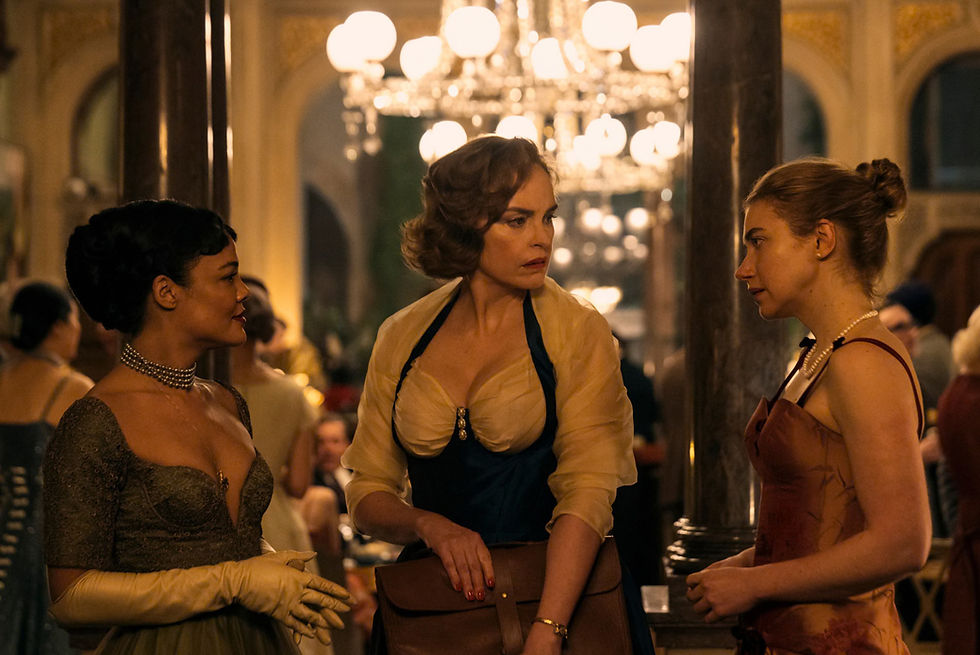
Stylistically, DaCosta blends the brooding and hyper Gothic tones of Cary Joji Fukunaga’s Jane Eyre from 2011, with the wild, horny and vibrant feminine spirit of Emerald Fennell’s instant cult classic Saltburn from 2023; a blend we as the audience didn’t know we needed, but cannot get enough of once the first frames of the film begin.
Hedda was a film that immediately caught my attention, from its first scene. DaCosta, who approached this film with unfavourable circumstances, after her very public and vocal departure from Disney’s The Marvels, decided to tackle Ibsen’s classic play and a passion project with intense bravado and a no-holds barred approach, quite differently than her experiences with Marvel Studios. This time, MGM/Amazon entrusted their faith in DaCosta, and gave her free reigns to breathe new life in Hedda Gabler that showcases her and portrays her similarly to a reality television house wife, than a classic stage icon over the last century.
It becomes apparent quickly that this adaptation of Hedda succeeds tremendously greatly to the heavy collaboration between a director and star who entrusts their complete faith in one another and allows the artist and brilliance of one another to shine.
DaCosta’s flexes all her directorial muscles in many ways with Hedda; from a sleigh shot that absolutely has the audience’s jaws on the ground when Hedda and the audience first see Eileen, to some amazing tracking shots and long takes that draws the audiences closer with each passing second and minute, DaCosta shines like never before and shows her growth as a filmmaker, her passion as a cinephile and her talents behind the camera with her most confident and easily, the best film of her career.
Thompson delivers the her best performance to date as Hedda Gabler. Tessa’s depiction of Gabler is easily her best work , showing a more dominant side to her acting and showcasing and guiding a talented cast with true triumph, as well as allowing different sides to her comedic, dark and dramatic acting tones to truly lead a feature to absolute excellence. Thompson commands every inch of the screen, whether it be her sexual prowess, allure, manipulation or devastating demise, Thompson becomes Hedda Gabler and Hedda Gabler becomes Tessa Thompson; the both live and breath within one another, hand in hand.
DaCosta treats Hedda like the legend she is, and also pays tremendous homage to the actors who have played Hedda in the past, both on the screen and on stage. DaCosta cleverly casts Nina Hoss as Gabler’s not so secretive love interest, Eilert Lövborg (changed to Eileen Lövborg), changed Judge Roland Brack’s to a strong and advert black man (Nicholas Pinnock) and takes so many creative yet daringly original and frantically alluring changes to the original text, only to make it a more contemporarily, engaging and tremendously enjoyable period piece, and quite possibly, the best period piece of 2025.
Hedda should be required and mandatory viewing when it gets released on Prime during the Halloween season to show that streaming produced films can be well done, artistic and engaging to audiences. Even more so, audiences should take it upon themselves to seek out Hedda in theatres if it get a limited theatrical release, because many off the compassionate and high cinema IQ shots of DaCosta’s take on a classic stage play should be experienced on the big screen.
Hedda proves that a little chaos and anarchy in cinema, goes a long way; and may perhaps be, very very good for the culture. One thing is for sure, it is a pleasure meeting this Hedda Gabler. Enchante.
Night Film Reviews: 8.5 Out of 10 Stars.
🌕🌕🌕🌕🌕🌕🌕🌕🌗🌑


Comments